Keep the rest short
After a strain, rest is usually only a couple of days. Keep it short, and keep the rest of you moving.

 Reviewed by Ellie Brandt, Principal physiotherapist, September 2026
Shoulder pain is common, and usually it isn't a sign of anything serious. The pain may come from the muscles and tendons around the joint, the joint itself, or sometimes your neck.
We'll tell you what we think is going on, in plain English. If it needs a scan or a doctor first, we'll say so.
Includes rotator cuff problems, bursitis, tendonitis and frozen shoulder.
Usually
Sore, overused tendons around the joint, often with bursitis.
Up to 2 in 3 people have shoulder pain at some point. Usually it isn't a sign of anything serious, and often the exact cause can't be pinned down. It can still be treated. The rotator cuff is four muscles and their tendons that keep the shoulder stable. Overuse or weakness can make it sore. The tendons and the small fluid sacs around the joint can get irritated too, often together. That's bursitis.
Sometimes
The joint capsule thickens and stiffens. More common after 40.
In a frozen shoulder, the capsule around the joint thickens, and the shoulder gets painful and stiff. It's more common after 40. Osteoarthritis can cause shoulder pain too.
Sometimes
Pain can start in the neck or spine and spread into the shoulder.
Pain can spread from the shoulder into your arm or neck. Sometimes it starts in the neck or spine instead.
Rarely
Shoulder pain with shortness of breath can be a heart attack.
Occasionally, someone having a heart attack has shoulder pain and shortness of breath. The next section says what to do.
In many cases, shoulder pain can be diagnosed without a scan.
So we start with a careful look at how it moves.
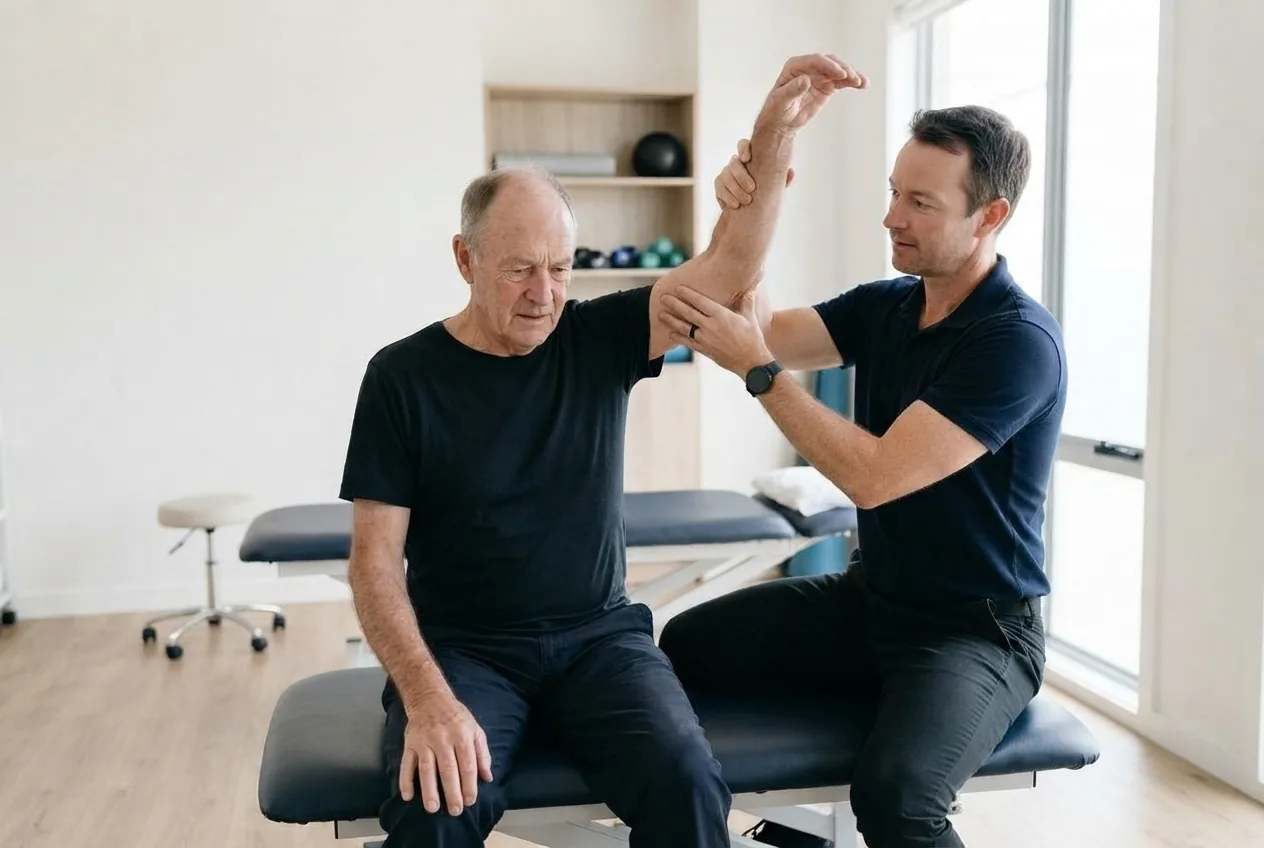
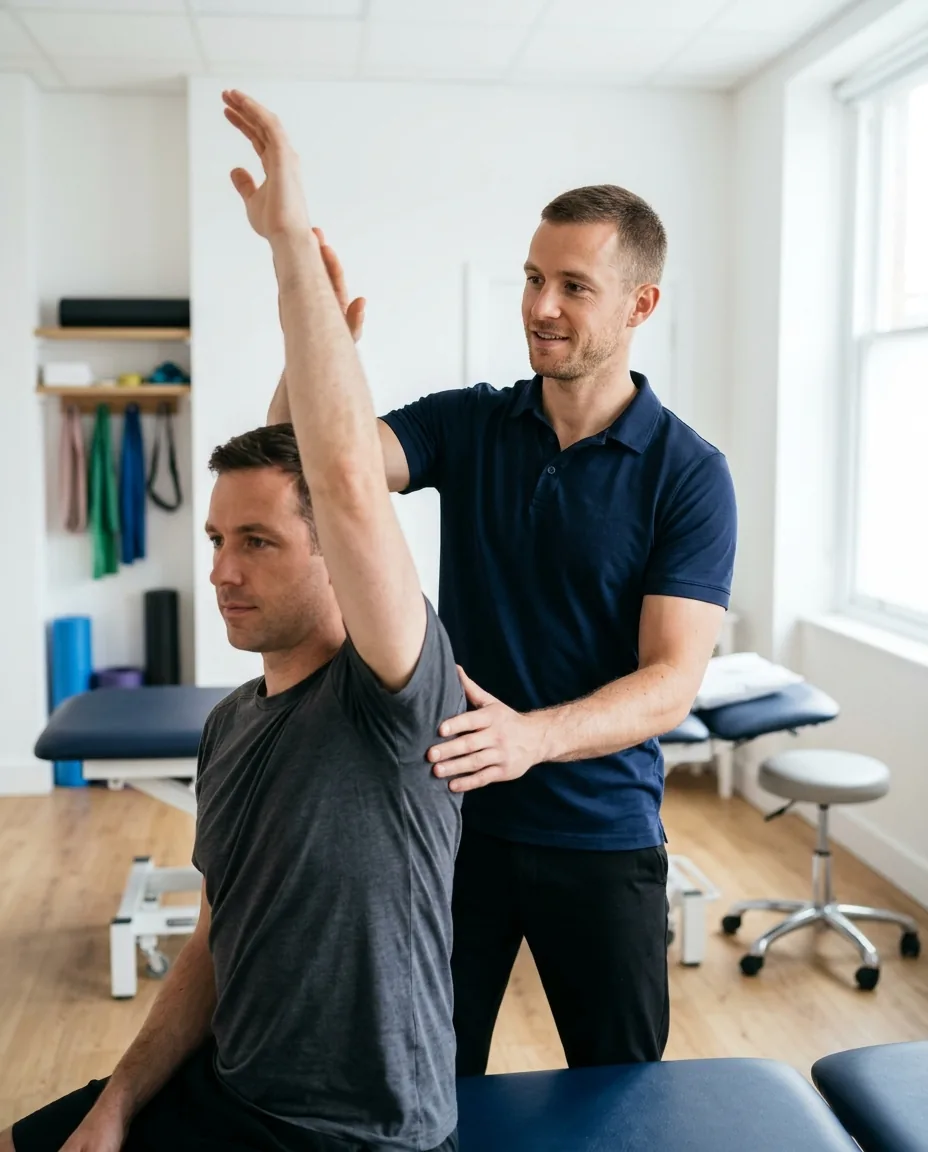
The movements that hurt: reaching up, out to the side, behind your back.
Strength on both sides. Your neck, because shoulder pain sometimes starts there. We'll explain what the checks tell us.
For a strain, physio and a short rest may be enough to settle it.
If it needs rest, that's usually only a couple of days. After that, the work is strengthening, built up in steps around your training or your day. You'll have your exercises written down or in an app, with what each one's for.
We work out which lifts to keep, which to change and which to park for now.
If it's worse after a day at the desk, we look at how you sit and work.
Physio can help most once it's in the stiff or easing stage.
The exercises work on movement, and we change anything that makes the pain worse.
We'll tell you.
Your GP can talk you through other options, like an injection.
Source: healthdirect, "Shoulder pain", last reviewed June 2023
Call 000 straight away and ask for an ambulance if you also have trouble breathing and your chest feels tight. Shoulder pain can be a sign of a heart attack.
Get medical help straight away if you've injured your shoulder and the joint looks deformed, you can't use your shoulder, the pain is intense, or it swells up suddenly.
See your GP if:
Most shoulder strains settle. While yours does:
After a strain, rest is usually only a couple of days. Keep it short, and keep the rest of you moving.
In the first few days after an injury, a cold pack on the sore spot. After that, a hot pack to help the muscles relax.
Lying on the sore side often sets it off. Try your other side or your back while it settles.
Warm up before training and stretch after. Watch how you lift and carry heavy things, and take breaks from the desk.
If it's not easing, or you want to know what's going on and what to do about it, that's what an assessment is for. No GP referral needed for private physio. If it started with a fall, see your GP first.
About 45 minutes, one-on-one the whole time.
How it started. What sets it off: the press, the shelf, the desk, the pool. What you've already tried, and what happened. What you want to get back to.
How far it reaches up, out to the side and behind your back, and where it catches. Strength on both sides.
Your neck, because shoulder pain sometimes starts there.
We'll explain each test, and ask before we touch.
What we think is going on, in words that make sense.
If you need a scan or a GP first, we'll say so.
You leave with your exercises written down or in an app, and the lifts sorted: keep, change, park for now.
We'll tell you roughly how many visits we expect, and why. If that changes, we'll tell you.
No packages to buy. You book one visit at a time.

Physiotherapist
Mon, Wed, Thu, Fri“I spent four years helping office and warehouse teams with back pain before Kestrel.”
Lower back painNeck painShoulder pain
Book with TomFor many strains, physio and a short rest may be enough to settle it. The plan is a check of how it moves, strengthening built up in steps, and changes to what sets it off. If yours needs a scan, a doctor or other options, we'll tell you, and send you to your GP.
Often not. In many cases, shoulder pain can be diagnosed without one. Scans help in certain situations, like an injury that needs looking into. If that's you, we'll tell you why and send you to your GP.
Usually not completely. If your shoulder needs rest, it's usually only a couple of days. Then we work out which lifts to keep, which to change and which to park for now.
Often it's both, together. The rotator cuff is four muscles and their tendons that keep the shoulder stable, and overuse or weakness can make it sore. The tendons and the small fluid sacs around the joint can get irritated with it: that's bursitis, and what people often call impingement. We test it at your first visit and tell you what we think.
We'll tell you what we think after the assessment. A frozen shoulder usually comes on slowly. It's mostly painful at first, then stiff, then it eases. How long that takes is different for different people.
Lying on the sore side is a common way shoulder pain shows up. Try the other side or your back while it settles. If it hurts when you're resting your shoulder and it isn't going away, see your GP as well as us.
Pick a time online, or call and we'll help you choose the right appointment.